The "Code Red" Update: Why OpenAI Rushed GPT-5.2
Facing sudden pressure from Google Gemini 3 and Claude Opus 4.5, OpenAI accelerated GPT-5.2 in a strategic "Code Red" move. We break down the performance leaps, the hidden trade-offs, and why this update is more than just a patch.

Giuseppe Gaspari
Wait & See
Bubble Score
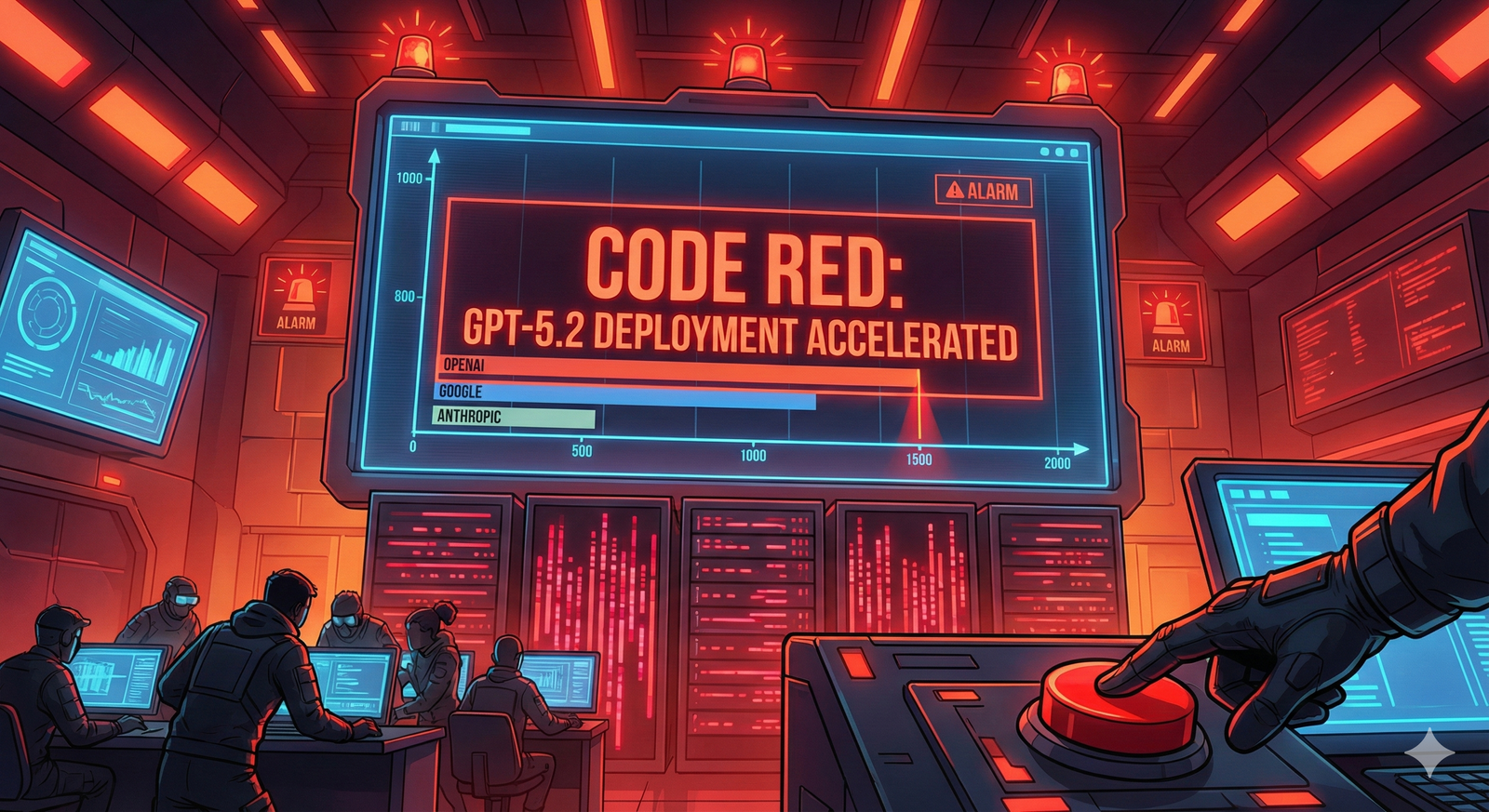
OpenAI accelerated GPT-5.2's release due to a "code red" directive meant to counter Google's rapid advancements and regain industry leadership. While GPT-5.1 was built for friendliness, 5.2 is built for war.
The "Code Red" Trigger
OpenAI released GPT-5.1 in November 2025, billing it as a conversational upgrade. It introduced Instant and Thinking modes, tone-of-voice presets, and improved instruction following[1]. However, the competitive landscape shifted overnight.
Google released Gemini 3 in late November 2025, topping several AI benchmarks[2]. Meanwhile, Anthropic launched Claude Opus 4.5 with superior coding and reasoning abilities[3].
"GPT-5.2 was not simply an incremental update—its release timing was strategic, aimed at regaining leadership."
In response, CEO Sam Altman issued an internal directive to pause advertising plans and reassign engineers to fast-track GPT-5.2, moving its release from late December to around 9 December 2025[4][5].
The Data: GPT-5.2 vs GPT-5.1
The update represents a pivot from "conversational" to "capable." Here's the breakdown:
| Feature | GPT-5.1 | GPT-5.2 |
|---|---|---|
| Software Engineering | 50.8% (SWE-Bench) | 55.6% (New SOTA)[6] |
| Reasoning (GDPval) | 38.8% Win Rate | 70.9% Win Rate[7] |
| Context Window | Degrades over long text | 400k tokens (Near 100% recall)[8] |
| Hallucinations | Standard Baseline | 30% Reduction[9] |
| Vision & Charts | Often mis-identified UI | Error rates cut ~50%[10] |
| Tool Calling | Inconsistent | 98.7% on Tau2-bench[11] |
| Pricing (Output) | $10 / 1M tokens | $14 / 1M tokens (~40% higher)[12] |
Why the Rushed Release?
Competitive Pressure
Google's Gemini 3 stunned the industry by topping leaderboards in reasoning and long-context tasks[2]. ChatGPT usage growth had slowed while Gemini reached 650 million monthly active users[13]. Internal memos directed engineers to accelerate core improvements and postpone ad-related projects.
GPT-5.1 Criticisms
Despite friendlier tone options, 5.1 felt "cold and clinical" to many users[14]. Developers complained that Codex capabilities were degrading—slower responses, superficial code suggestions[15].
Economic Stakes
OpenAI has committed to over $1.4 trillion in AI-infrastructure investments and needs to maintain market leadership to justify them[16]. Keeping ChatGPT's 800 million weekly active users engaged is critical.
Why the Community is Divided
The Bull Case: "A Professional Workhorse"
For developers and analysts, GPT-5.2 is a massive win. The 30% reduction in hallucinations and the new /compact endpoint for long context make it viable for enterprise RAG pipelines where 5.1 failed[9].
AI strategist Allie K. Miller noted that 5.2 stayed with a line of thought longer and even wrote code to improve its own OCR during a task[17]. Early tests show it can debug large codebases and handle investment-banking spreadsheets with 9.3% higher accuracy.
The Bear Case: "Over-Regulated & Expensive"
The "friendliness" of 5.1 is gone. Users report that 5.2 feels "cold," often responding with 50+ bullet points and excessive safety warnings[18]. The 40% price hike has priced out many hobbyist developers[12].
There's also controversy around benchmarks. Critics allege OpenAI used an "xhigh" reasoning setting unavailable to the public to inflate scores against Gemini 3[19]. Some reviewers found Instant mode sometimes performs worse than 5.1[20].
Verdict
GPT-5.2 is a wartime release. It sacrifices personality and affordability for raw power and benchmark dominance. The model delivers genuine improvements—better long-context reasoning, reduced hallucinations, stronger coding—but at the cost of higher prices and a more restrictive style.
OpenAI narrows the gap with Google and Anthropic, but the "Code Red" nature of this release suggests they're no longer the undisputed king—they're fighting for every inch of ground.
Sources
- GPT-5.1: A smarter, more conversational ChatGPT | OpenAI
- Sam Altman Declares 'Code Red' for ChatGPT | MacRumors
- GPT-5.2 Review | Turing College
- OpenAI is getting ready to launch GPT-5.2 soon | The Verge
- What Is OpenAI GPT-5.2 'Code Red': Explained | Metana
- Introducing GPT-5.2 | OpenAI (benchmarks, context, hallucinations)
- GPT-5.2 vs GPT-5.1 Full Comparison
- Strengthening ChatGPT's responses in sensitive conversations | OpenAI
- OpenAI releases GPT-5.2 after "code red" | Ars Technica
- GPT Codex quality degrading | OpenAI Community
- Allie K. Miller GPT-5.2 Review | LinkedIn
- Vibe Check: GPT-5.2 Is an Incremental Upgrade | Every
- GPT-5.2 overregulated discussion | Reddit
- I tested GPT 5.2 and it's just bad | Medium
- OpenAI GPT-5.2: the "cheating" controversy | Medium
Giuseppe Gaspari
Founder & Editor of Will It Bubble. Cutting through the AI hype to share what actually matters.