Vision Transformers: Approaching but Not Achieving Human-Level Object Recognition
The claim that Vision Transformers have achieved human-level object recognition is partially true but significantly oversimplified. ViTs now exceed reported human performance on ImageNet—91% vs 94.9%—yet profound differences in how humans and machines see remain.

Frank Koziarz
Grounded
Bubble Score
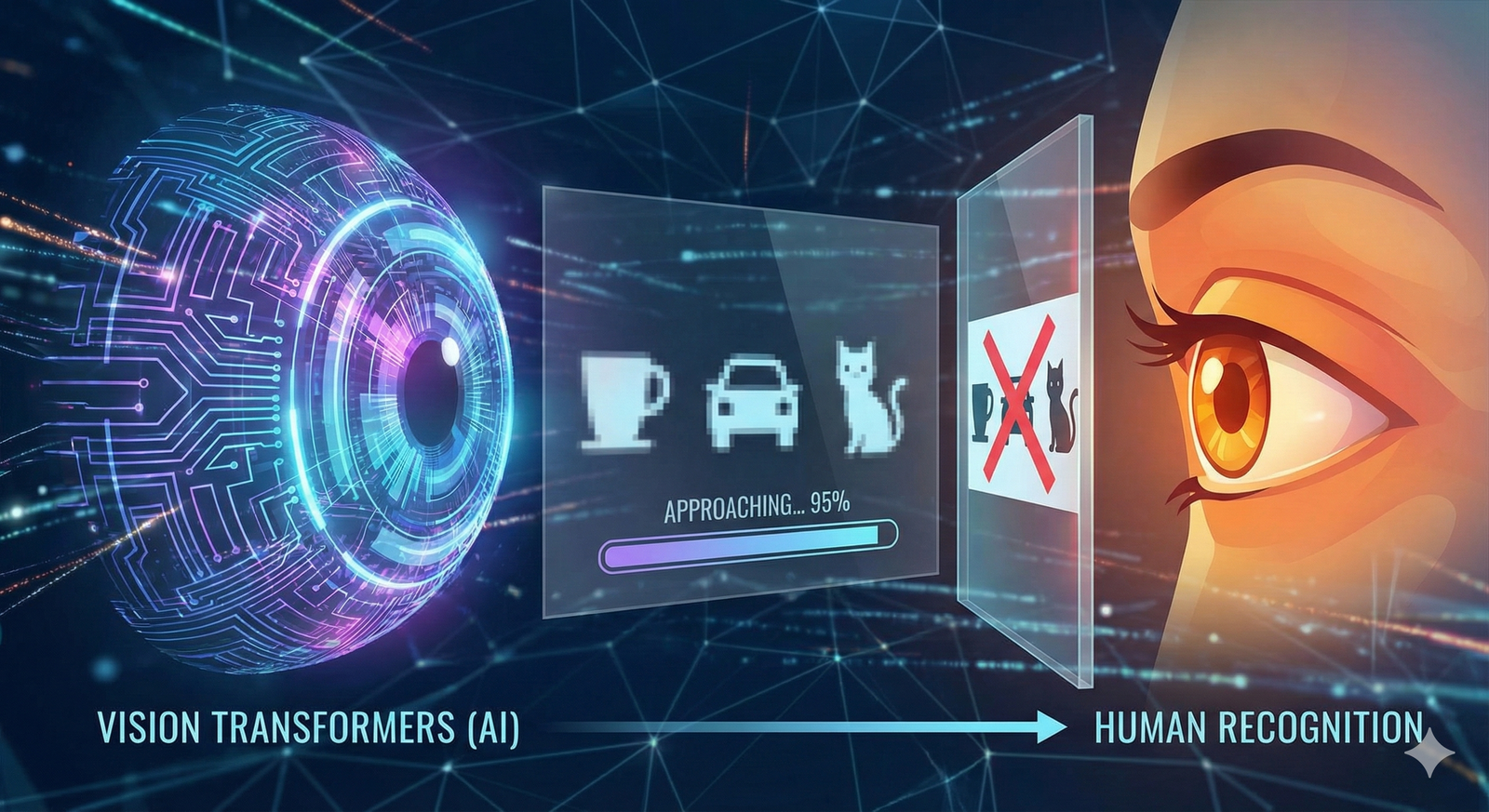
The claim that Vision Transformers have achieved human-level object recognition is partially true but significantly oversimplified. ViTs now exceed reported human performance on ImageNet classification—91% accuracy versus the 94.9% benchmark—yet this comparison obscures profound differences in how humans and machines see. Research from 2023-2025 reveals a nuanced picture: ViTs match or surpass humans on specific narrow tasks while failing dramatically on capabilities central to human vision, including recognizing objects under occlusion, learning from few examples, and making human-like errors.
The Benchmark Numbers Tell a Misleading Story
State-of-the-art Vision Transformers have achieved remarkable accuracy on standard benchmarks. CoCa achieves 91.0% top-1 accuracy on ImageNet-1K [1], while EVA-02-L reaches 90.0% with only 304 million parameters [2][3]. Google's ViT-22B, the largest dense Vision Transformer at 22 billion parameters, achieves 89.5% accuracy on ImageNet with frozen features and 85.9% zero-shot accuracy—meaning it can classify images without task-specific training [4][5].
These numbers appear impressive against the commonly cited human baseline of 5.1% top-5 error rate (approximately 94.9% accuracy), established by Andrej Karpathy in 2014 [6]. However, this baseline reveals more about benchmark limitations than human capabilities. Karpathy spent hours training himself to distinguish 120+ dog breeds and labeled images at one per minute—hardly representative of natural human vision. As he noted: "Human accuracy is not a point. It lives on a tradeoff curve." His labmates with minimal training achieved only 85-88% accuracy, while he estimated that dedicated expert ensembles might push accuracy to 97% [6].
On object detection benchmarks like COCO, ViT-based models now achieve approximately 66% box Average Precision (Co-DETR), with GroundingDINO 1.5 Pro reaching 54.3% AP in zero-shot settings [7]. Meta's DINOv2 demonstrates that self-supervised ViTs can achieve 86.5% ImageNet accuracy without any labels, suggesting fundamental visual understanding rather than task-specific memorization [8][9].
Direct Comparison Studies Reveal a Persistent Gap
The most rigorous human-ViT comparisons come from the Bethge Lab at University of Tübingen, led by Matthias Bethge, Robert Geirhos, and Felix Wichmann. Their landmark NeurIPS 2021 study "Partial Success in Closing the Gap Between Human and Machine Vision" conducted 85,120 psychophysical trials across 90 human participants in controlled laboratory conditions [10][11].
Key Finding from the Bethge Lab
The findings were sobering: while the "longstanding distortion robustness gap between humans and CNNs is closing," with best models exceeding human feedforward performance on most out-of-distribution datasets, a substantial image-level consistency gap remains [10]. Humans and models make different errors. Even when accuracy matches, the underlying visual strategies diverge fundamentally.
A critical discovery from this research program is the texture-shape bias discrepancy. Geirhos et al.'s 2019 ICLR paper documented that when shown images with conflicting texture and shape cues (like a cat shape with elephant texture), humans rely on shape 96% of the time while standard CNNs rely on texture 70-80% of the time [12]. Vision Transformers improved dramatically—ViT-22B achieves 87% shape bias, the highest recorded in machine learning—but still fall short of human shape-based recognition [4].
MIT researchers (David Mayo, Boris Katz, Andrei Barbu) introduced Minimum Viewing Time (MVT) as a difficulty metric in their NeurIPS 2023 paper [13]. Their key finding: "Nearly 90% of current benchmark performance is derived from images that are easy for humans." As image difficulty increases, "model performance drops precipitously while human performance remains stable" [13]. This suggests benchmark saturation masks a much larger performance gap on challenging real-world images.
ViTs Excel on Specific Narrow Tasks
Vision Transformers genuinely match or exceed humans in several domains. On standard ImageNet classification, models have been superhuman since 2015 when ResNet achieved 3.57% top-5 error versus Karpathy's 5.1% [14]. Current models achieve approximately 3.5% top-5 error—genuinely better than trained human experts on this artificial 1,000-class task [1].
Face verification systems powered by transformer architectures exceed human accuracy on benchmark datasets. In medical imaging, GPT-4V achieves 49-57% accuracy on radiology questions versus 61% for radiologists—approaching but not matching expert performance [9]. Some specialized systems match radiologist accuracy on specific narrow tasks like detecting diabetic retinopathy or certain cancers.
ViTs show particular strength on out-of-distribution generalization compared to CNNs [15]. Google's ViT-22B sets state-of-the-art on ObjectNet, a challenging benchmark with unusual viewpoints and backgrounds [4]. The BAAI's EVA-02-CLIP-E/14+ achieves 80.9% averaged accuracy across six ImageNet variants with only 1.1% drop from standard ImageNet—demonstrating robust generalization [2]. Vision-language models like CLIP-based systems show the most human-like robustness patterns.
Four Critical Areas Where ViTs Still Fail Humans
1. Few-Shot Learning: The Largest Gap
Humans can recognize a new object category from a single example; ViTs require massive pre-training datasets [16]. Standard ViTs need extensive fine-tuning to achieve competitive few-shot performance, while humans leverage compositional understanding and prior knowledge effortlessly [17][18]. Approaches like Meta-DETR and mask-guided ViTs attempt to address this but remain far from human efficiency.
2. Adversarial Robustness: Fundamental Vulnerabilities
While ViTs are orders of magnitude more robust than CNNs to adversarial attacks [19], they remain vulnerable to perturbations imperceptible to humans [20][21]. ViTs are particularly susceptible to adversarial patch attacks that misdirect attention mechanisms. The existence of adversarial examples that fool models with high confidence while appearing unchanged to humans demonstrates fundamentally different feature representations.
3. Recognition Under Occlusion: Brittleness Exposed
Research from Alan Yuille's group at Johns Hopkins shows that standard deep networks are "significantly less robust to partial occlusion than humans" [22]. ViTs retain approximately 60% accuracy on ImageNet with 80% random occlusion—impressive, but humans maintain much higher performance [23]. Diffuse occlusion (like seeing through fences or foliage) "greatly reduces deep model accuracy compared to humans" [22].
4. Systematic Error Pattern Differences
Even when accuracy matches, the Geirhos lab found that models "systematically agree in their errors with each other but not with humans" [10][24]. This error consistency gap indicates different underlying visual representations, not just different performance levels. Models exploit statistical regularities in training data that humans don't use.
The Measurement Problem Undermines Human-Level Claims
Jeffrey Bowers and colleagues at University of Bristol published a landmark critique in Behavioral and Brain Sciences (2022): "Deep Problems with Neural Network Models of Human Vision" [25]. They argue that "deep neural networks account for almost no results from psychological research" and that "many unwarranted conclusions regarding DNN-human similarities are drawn because of a lack of severe testing" [25][26].
The foundational human baseline itself is problematic. The 5.1% error rate comes from just 1-2 highly trained expert labelers classifying 1,500 images—hardly representative of human visual capabilities [6]. ImageNet's 1,000-class fine-grained categorization (including 120+ dog breeds) represents an artificial task that "causes difficulties for people who do not have sufficient prior knowledge" [27]. The dataset was annotated via binary queries ("Is this a Border Terrier?") but tested via 1,000-way classification—fundamentally different tasks.
Label noise compounds the problem. Estimates suggest over 6% of ImageNet validation labels are wrong and approximately 10% contain ambiguous or erroneous labels [27][28]. Models trained to match these labels may learn noise rather than visual understanding. As the Carnegie Endowment notes, benchmarks "might not be measuring the full capabilities that humans have in the domain in question" [29].
A 2025 arXiv paper "On Benchmarking Human-Like Intelligence in Machines" identifies key shortcomings: "a lack of human-validated labels, inadequate representation of human response variability and uncertainty, and reliance on simplified and ecologically-invalid tasks" [30]. The authors recommend collecting graded judgments, measuring human response variability, and using ecologically valid tasks rather than artificial classification challenges.
Recent Breakthroughs Advance Alignment with Human Vision
Meta's DINOv3 (2025) represents the current frontier, with 7 billion parameters trained on 1.7 billion images—12× larger than DINOv2's training set [31]. Key innovations include Gram Anchoring for training stability and RoPE position embeddings. Performance improves dramatically: +6 mIoU on ADE20K segmentation, +6.7 points on video tracking, and +10.9 GAP on instance retrieval versus DINOv2 [31]. Critically, frozen DINOv3 features work "out of the box" without fine-tuning.
| Model | Key Achievement | Human Alignment |
|---|---|---|
| ViT-22B | 89.5% ImageNet, 85.9% zero-shot | 87% shape bias |
| DINOv3 | 7B params, 1.7B images | Best frozen features |
| Gemini 2.5 Pro | 81.7% MMMU | 1M token context |
| GPT-4V | 74.1% low-level vision | "Junior human level" |
Multimodal models show the strongest human-like behavior. Gemini 2.5 Pro (March 2025) achieves 81.7% on MMMU (multimodal understanding) with a 1M token context window [32]. Claude 3.5 Sonnet excels at interpreting charts, graphs, and imperfect images. GPT-4V approaches "junior human level" (74.1% vs 74.3%) on low-level vision benchmarks. These models integrate visual understanding with language reasoning in ways that better approximate human cognition.
The ViT-22B results from Google Research (ICML 2023) mark the closest recorded alignment with human visual processing [4]. Beyond achieving state-of-the-art accuracy, ViT-22B achieves 87% shape bias—approaching the human 96%—and shows the highest error consistency with human participants [4][33]. Authors Mostafa Dehghani, Josip Djolonga, and Robert Geirhos conclude that "ViT-22B measurably improves alignment to human visual object recognition," while acknowledging "there are still many important differences" [33].
Conclusion
The claim that Vision Transformers achieve human-level object recognition reflects genuine progress but oversimplifies a complex reality. On narrow classification benchmarks, ViTs now exceed the performance of trained human experts. But these benchmarks systematically undersample the images humans find easy while overweighting artificial fine-grained distinctions.
Three Key Gaps Persist
- Error Consistency Gap: ViTs make fundamentally different errors than humans
- Representation Gap: ViTs rely more on texture than shape (87% vs 96%)
- Robustness Gap: ViTs fail on difficult images where humans maintain accuracy
The most significant limitation is sample efficiency—humans learn new visual concepts from single examples while ViTs require billions of training images.
Recent work suggests these gaps are narrowing. ViT-22B's shape bias approaches human levels; DINOv3's frozen features generalize impressively; multimodal models show more human-like reasoning. But achieving true human-level vision likely requires architectural innovations beyond scaling current approaches—models that can compose concepts, learn efficiently from few examples, and represent objects the way humans do rather than just classifying them correctly on average.
References
- Papers with Code. "ImageNet Benchmark (Image Classification)."
- Fang, Y., et al. "EVA-02: A Visual Representation for Neon Genesis." arXiv:2303.11331 (2023).
- Fang, Y., et al. "EVA-02: A visual representation for neon genesis." Image and Vision Computing (2024).
- Google Research. "Scaling vision transformers to 22 billion parameters." (2023).
- MarkTechPost. "Google AI Researchers Propose ViT-22B." (2023).
- Karpathy, A. "What I learned from competing against a ConvNet on ImageNet." (2014).
- Roboflow. "Best Object Detection Models 2025." (2025).
- Emergent Mind. "DINOv2: Scalable Self-Supervised ViT Model."
- arXiv. "Evaluating Vision Foundation Models for Medical Image Analysis." arXiv:2312.02366.
- Geirhos, R., et al. "Partial success in closing the gap between human and machine vision." NeurIPS 2021.
- Geirhos, R., et al. NeurIPS 2021 Paper PDF.
- Geirhos, R., et al. "ImageNet-trained CNNs are biased towards texture." arXiv:1811.12231 (2018).
- Mayo, D., Katz, B., & Barbu, A. "How hard are computer vision datasets?" NeurIPS 2023.
- Statista. "ILSVRC AI error rates 2010-2017."
- Zhou, D., et al. "Delving Deep into the Generalization of Vision Transformers." arXiv:2106.07617 (2021).
- DigitalOcean. "Everything you need to know about Few-Shot Learning."
- PMC. "Reproducing Few-Shot Learning Capabilities Using Vision Transformers." (2025).
- ResearchGate. "Vision Transformer Encoders and Few-shot Learning." (2023).
- Nature Communications. "Adversarial attacks and robustness in computational pathology." (2022).
- ResearchGate. "On the Robustness of Vision Transformers to Adversarial Examples." (2022).
- Springer. "Generation and Countermeasures of adversarial examples." AI Review (2024).
- Wiley. "Mitigation of Effects of Occlusion on Object Recognition." (2016).
- Naseer, M., et al. "Intriguing Properties of Vision Transformers." NeurIPS 2021.
- Geirhos, R., et al. "Beyond accuracy: quantifying trial-by-trial behaviour." arXiv:2006.16736 (2020).
- Cambridge Core. "Deep Problems with Neural Network Models of Human Vision." BBS (2022).
- ScienceDirect. "On the importance of severely testing deep learning models." (2023).
- Shankar, V., et al. "Evaluating Machine Accuracy on ImageNet." ICML 2020.
- ScienceDirect. "ImageNet Challenge - an overview."
- Carnegie Endowment. "AI Has Been Surprising for Years." (2025).
- arXiv. "On Benchmarking Human-Like Intelligence in Machines." arXiv:2502.20502 (2025).
- Lightly AI. "DINOv3 Explained: Technical Deep Dive." (2025).
- Future AGI. "Gemini 2.5 Pro Benchmarks & Pricing Guide 2025."
- Geirhos, R. Personal Website.
Frank Koziarz
AI analyst and tech journalist covering the latest in artificial intelligence.