The Stargate Project: Inside OpenAI's $500 Billion Infrastructure Bet
A 10-gigawatt network. A $500 billion price tag. Five US states. We break down the massive joint venture between OpenAI, SoftBank, and Oracle that aims to secure American AI dominance.

Giuseppe Gaspari
Inflating
Bubble Score
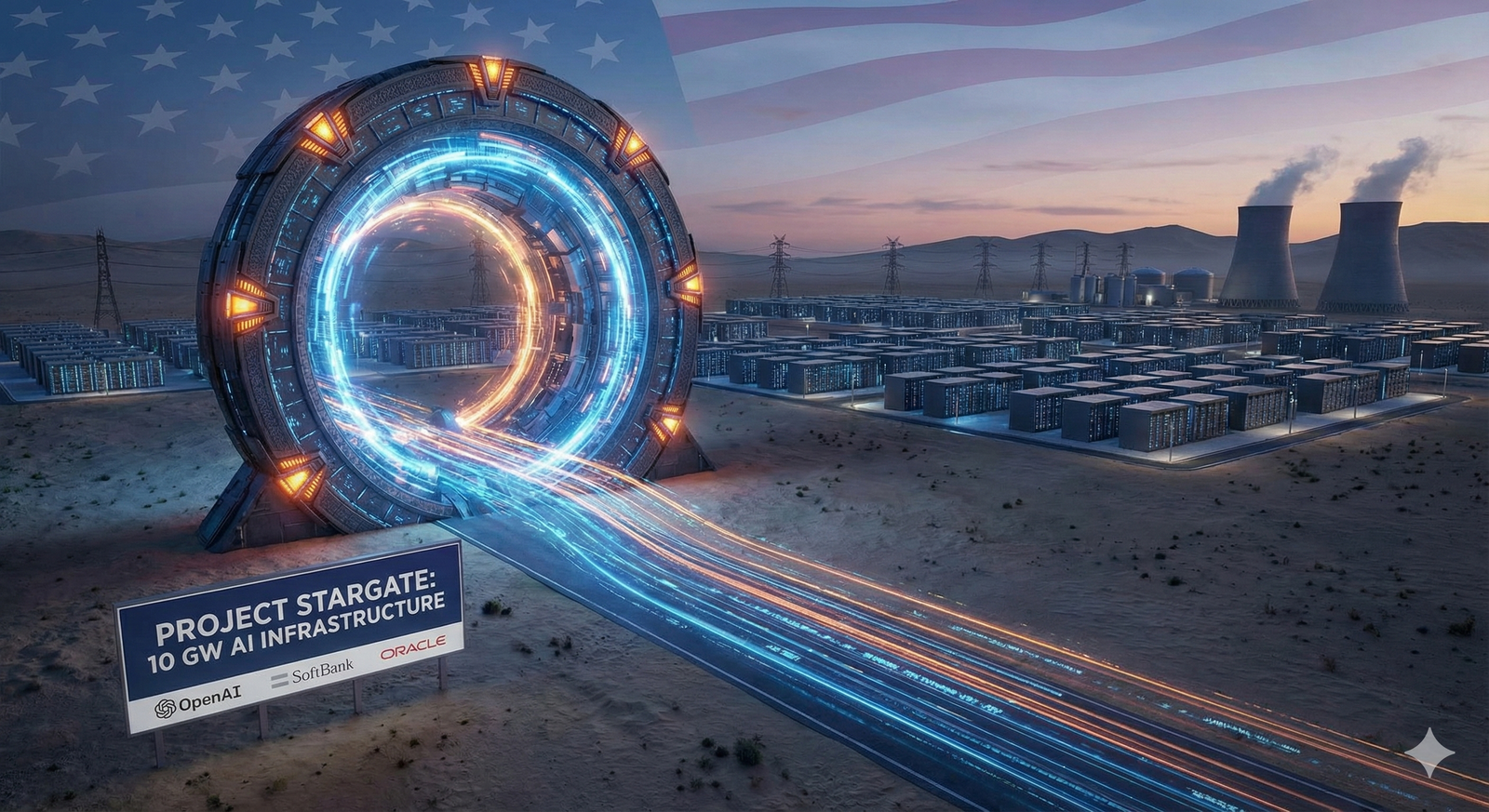
In January 2025, a coalition of tech giants and financiers unveiled Stargate—a private-sector joint venture designed to be the "Interstate Highway System" of Artificial Intelligence.
President Donald Trump endorsed the project at a White House event on 21 January 2025, framing it as a strategic initiative to "secure American leadership in AI." But behind the podiums lies a complex web of financing, engineering, and geopolitical maneuvering.
The Structure: Who Does What?
Stargate is not a standard partnership; it is a specialized consortium where each giant plays a specific role. SoftBank (led by Masayoshi Son) acts as the principal financier, Oracle provides the physical infrastructure and engineering, and OpenAI serves as the primary customer and operator.
The Scale is Unprecedented. To visualize 10 gigawatts of power: that is roughly equivalent to the electricity output of 10 nuclear reactors, or enough to power 7.5 million U.S. homes.
Phase 1: The U.S. Campus Rollout
The project is already moving dirt. The first Stargate campus in Abilene, Texas, projected to reach ~1 GW, already employs over 6,400 workers. Oracle began delivering NVIDIA GB200 racks to this site in June 2025.
In September 2025, the coalition announced five additional sites, bringing the total committed investment to over $400 billion. These sites are strategically located near power infrastructure:
| Location | Lead Developer | Status / Capacity |
|---|---|---|
| Abilene, Texas | Oracle | ~1 GW (Operational) |
| Shackelford, Texas | Oracle / Vantage | ~1.4 GW (Planning) |
| Lordstown, Ohio | SoftBank | ~1.5 GW (18-month timeline) |
| Milam County, Texas | SB Energy | 1.2 GW |
| Wisconsin | Oracle | Midwest Hub |
Global Ambitions: "OpenAI for Countries"
Stargate is not limited to the US. Under the "OpenAI for Countries" initiative, the project is expanding into allied nations to create sovereign compute capabilities.
- Norway (Narvik): A 230 MW facility running on 100% renewable hydropower, slated to scale to 520 MW.
- United Kingdom: A partnership with Nscale to deploy 31,000 GPUs for sovereign compute.
- UAE: A 1-GW project with G42, with 200 MW coming online by 2026.
The Criticisms: Bubble or Breakthrough?
Despite the high-profile endorsements, the project faces skepticism regarding its financial viability and environmental toll.
The Financial Risk
With OpenAI generating ~$20B in 2025 revenue, critics like Forbes argue the company cannot justify $1.4 trillion in infrastructure spending over 8 years. Hardware depreciation is a major risk: GPUs bought today may be obsolete in 4 years, potentially creating a "telecom-style" bubble.
The Environmental Cost
Gigawatt-scale centers require massive water for cooling. In Saline Township, Michigan, residents labeled a proposed site "uniquely evil." Environmental groups are calling for moratoriums, fearing the project will force a return to fossil fuels to meet energy demand.
Verdict: The New Oil
Stargate represents a shift in how nations view compute: not just as a commodity, but as strategic infrastructure akin to oil reserves or highway systems. If successful, it will cement OpenAI and Oracle as the unrivaled kings of the AI era. If it fails, it could trigger the largest tech-debt crisis in history.
For investors and builders, the message is clear: the AI infrastructure build-out is entering its industrial phase. The opportunities in semiconductors, renewable energy, and specialized construction are immense—but so are the risks.
Sources
- Announcing The Stargate Project | OpenAI
- OpenAI's Stargate Project: A Guide | IntuitionLabs
- Stargate Request for Proposal (RFP) | OpenAI
- OpenAI, Oracle, and SoftBank expand Stargate | OpenAI
- OpenAI, Oracle, SoftBank plan five new AI data centers | Reuters
- OpenAI, SoftBank invest $1 billion in SB Energy | Reuters
- What the Michigan Stargate site says about today's AI market | Latitude Media
- Why OpenAI's AI Data Center Buildout Faces A 2026 Reality Check | Forbes
- Trump, Stargate, DeepSeek: A new era for AI? | Chatham House
Giuseppe Gaspari
Founder & Editor of Will It Bubble. Cutting through the AI hype to share what actually matters.