Multimodal AI: The Defining Era of Unified Vision, Voice, and Beyond
With ChatGPT reaching 800 million weekly users and 54.6% of US adults using generative AI, multimodal systems that process text, images, audio, and video simultaneously have transformed from experimental to mainstream in under two years.

Frank Koziarz
Wait & See
Bubble Score
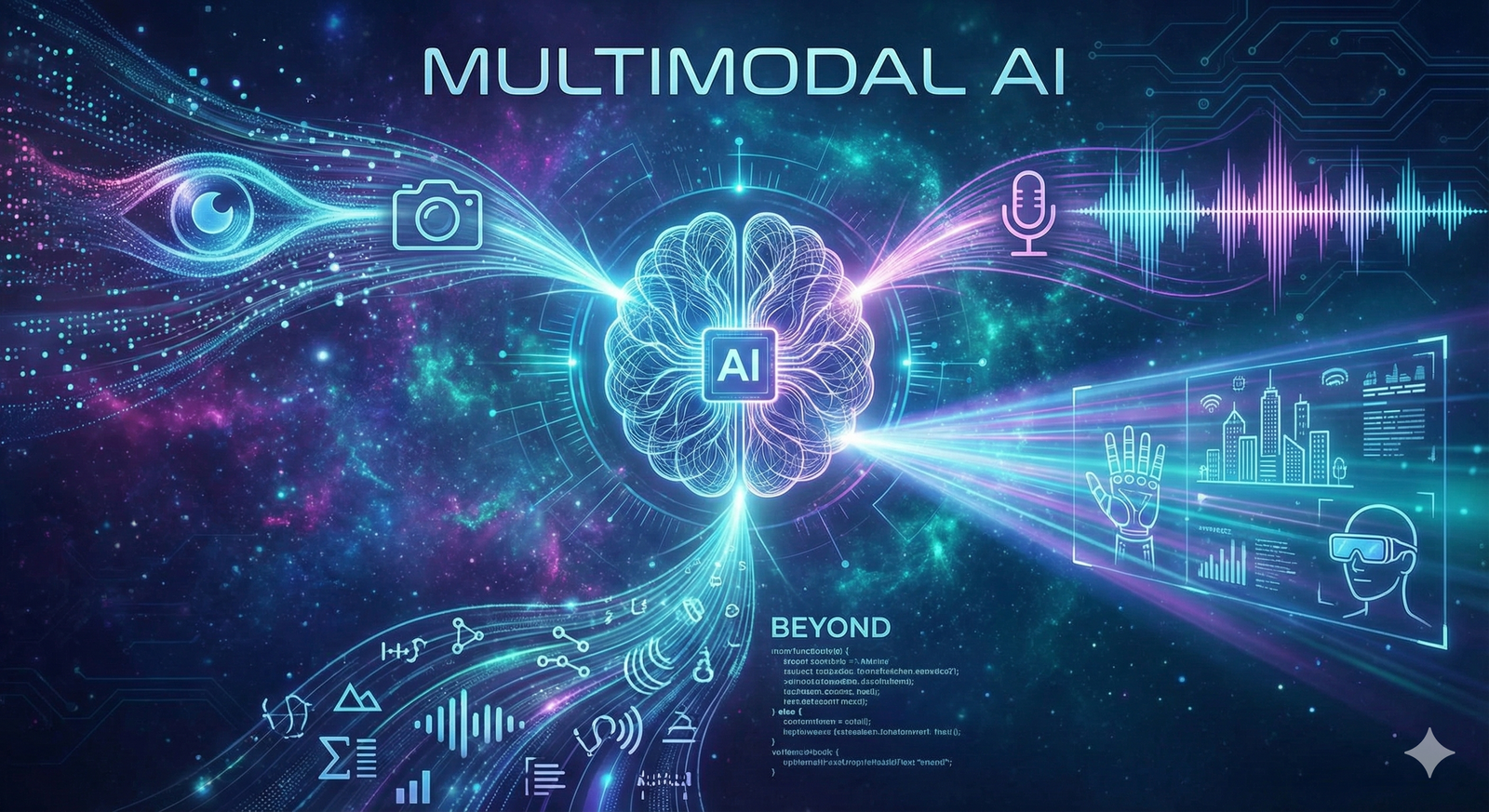
Multimodal AI—systems that process text, images, audio, and video simultaneously—has transformed from experimental capability to mainstream technology in under two years. With ChatGPT reaching 800 million weekly active users [1] and 54.6% of US adults now using generative AI [2], the shift to multimodal interaction represents the fastest technology adoption in history. The technical evolution from "pipeline" architectures (separate models chained together) to unified "omni" models marks a fundamental breakthrough: GPT-4o's 232-millisecond voice response time now matches human conversation pace [3], while context windows have expanded to 10 million tokens with Llama 4 Scout [4].
The implications extend across every domain. For developers, entirely new frameworks, APIs, and design patterns have emerged. For consumers, AI that can see, hear, and speak simultaneously is enabling transformative accessibility applications while raising profound privacy and trust concerns. This report synthesizes the current state, emerging modalities, 2026 predictions, and practical implications of this technological shift.
From Separate Pipelines to Unified Understanding
The term "multimodal" in AI has evolved from describing models that could handle multiple data types sequentially to systems with native, simultaneous cross-modal understanding. IBM defines it as "machine learning models capable of processing and integrating information from multiple modalities" [5], while academic researchers at Carnegie Mellon identify three key characteristics: heterogeneity of representations, connections between modalities, and meaningful interactions between data types.
The architectural transformation between 2024-2025 was decisive. Before May 2024, multimodal interactions required "pipeline" approaches—speech-to-text feeding into an LLM, then text-to-speech—with 2.8 to 5.4 second latencies [3]. When OpenAI released GPT-4o in May 2024, it demonstrated that a single neural network could process text, audio, images, and video inputs while generating outputs across modalities, reducing latency by an order of magnitude [6].
Major Multimodal Milestones (2024-2025)
- • March 2024: Claude 3 family with sophisticated vision [7]
- • May 2024: GPT-4o unified omni model
- • September 2024: Meta's first multimodal Llama 3.2 [8]
- • December 2024: Google's Gemini 2.0 announcing the "agentic era" [9]
- • April 2025: Llama 4's native multimodal architecture with mixture-of-experts [10]
Each release pushed toward deeper integration—from late fusion approaches that combined modality features at output to early fusion where text and vision tokens are trained jointly from pre-training.
2026 Brings Agents, World Models, and Video Maturity
Industry consensus converges on 2026 as the year multimodal AI shifts from experimentation to enterprise-scale deployment. Gartner projects that 40% of enterprise applications will integrate task-specific AI agents by year's end, up from less than 5% today [11]. McKinsey's research shows that while 88% of organizations now use AI in at least one function, only 6% qualify as "high performers" achieving measurable business impact—2026 will separate successful adopters from experimenters [12].
| Model | Expected | Key Capabilities |
|---|---|---|
| Gemini 3.0 | Early 2026 | Built-in reasoning, 60fps video, 10M+ context [13] |
| Claude 5 | 2026 | Hours-long reasoning, cross-system integration [14] |
| OpenAI Q1 Update | Q1 2026 | "Big upgrade" teased by Sam Altman [15] |
World models represent perhaps the most significant emerging capability. These systems learn to simulate reality from video data, enabling AI that understands object permanence, gravity, and realistic motion. World Labs (founded by Fei-Fei Li), Google DeepMind's Genie, and Runway's GWM-1 all represent early versions of technology that PitchBook projects could grow from $1.2 billion to $276 billion by 2030 in gaming applications alone [16].
The agentic dimension—AI systems that take autonomous actions rather than merely process inputs—is maturing rapidly. METR research shows AI task duration is doubling every 7 months; by late 2026, agents may autonomously execute 8+ hour workstreams [17]. Anthropic's Model Context Protocol (MCP) is emerging as an industry standard for agent-to-tool connections, enabling multimodal agents that can simultaneously watch video feeds, read documentation, and execute code.
New Senses Are Extending AI Beyond Sight and Sound
Beyond text, images, and audio, researchers are achieving breakthrough results across previously unexplored modalities:
Tactile Sensing: The "ImageNet Moment"
The F-TAC Hand (Nature Machine Intelligence, June 2025) demonstrated robotic manipulation with tactile sensing across 70% of the hand surface at 0.1mm resolution—significantly outperforming non-tactile systems. Carnegie Mellon's Sparsh foundation model trained on data from 460+ sensors across 60+ labs represents the first large-scale tactile AI model. Commercial applications are already deployed: Tesla Optimus incorporates fingertip sensors, Amazon Sparrow uses embedded tactile sensors reducing damage rates by 30%, and the Da Vinci 5 surgical system announced plans for haptic feedback integration.
Olfactory AI: Practical Accuracy Achieved
DGIST's graphene-based electronic nose (ACS Nano, May 2025) achieved 95%+ accuracy identifying fragrances using combinatorial coding—a system flexible enough to bend 30,000+ times [18]. Applications include breath-based disease detection for lung cancer and diabetes, food spoilage identification, and environmental monitoring [19].
3D Spatial Awareness: Gaussian Splatting Revolution
This technique, introduced at SIGGRAPH 2023, represents scenes as collections of 3D volumetric Gaussians that can be rendered much faster than neural representations like NeRF [20]. NVIDIA's July 2024 advance with 3D Gaussian Ray Tracing addressed prior restrictions on lens capture [21]. The integration with SLAM (Simultaneous Localization and Mapping) is enabling autonomous robots to navigate complex environments [22].
Embodied AI Is Commercializing Rapidly
Boston Dynamics' production-ready electric Atlas robot, unveiled at CES 2026, features 50+ degrees of freedom [23] powered by Large Behavior Models—450-million-parameter Diffusion Transformer architectures trained on proprioception, images, and language [24]. Figure AI's Helix system targets home environments [25], while 1X Technologies' NEO (1.6m tall, 30kg, 7.5 mph running speed) is testing in homes with plans for millions of units by 2028 at a price point of "a modest car" [26].
Brain-computer interfaces are accelerating through US-China competition. Columbia's BISC chip (December 2025) features 65,536 electrodes across 1,024 channels in an ultra-thin, wireless form factor. China conducted 31 BCI trials in 2024 (3x the previous year), with 18 already completed in early 2025. Market forecasts range from $25 billion+ by 2030 to $1.6 trillion by 2045.
Developers Face New APIs, Architectures, and Paradigms
The multimodal shift has generated an entirely new development ecosystem. Every major AI provider now offers multimodal APIs:
| Provider | Key Features |
|---|---|
| OpenAI | GPT-4o accepts text/images via Chat Completions API, 170 tokens per 512px tile, vision fine-tuning at $25/1M tokens [27][28] |
| Google Gemini | 3.0 API with thinking_level, media_resolution params; real-time WebSocket streaming with VAD [29][30] |
| Anthropic Claude | All 3+ models support vision, up to 100 images per request, token calc: (width × height) / 750 [31][32] |
| Meta Llama 4 | First natively multimodal open-source using early fusion, Scout with 10M token context [33] |
| Amazon Bedrock | Nova series from text-only Micro to multimodal Pro, plus Canvas and Reel for generation [34] |
Framework support has matured significantly. LangChain now structures HumanMessage content as arrays containing dedicated ImageContent and AudioContent types [35]. LlamaIndex offers MultiModalVectorStoreIndex for indexing text and images in separate vector collections with unified retrieval. Both frameworks support the dominant retrieval patterns: dual-vector stores with parallel similarity search, image-to-text summarization via VLMs, and CLIP embeddings in shared semantic spaces.
New Development Paradigms
- • Multimodal Chain-of-Thought: Structures reasoning across modalities
- • Multimodal RAG: Combines semantic text search with visual similarity matching [36]
- • Agentic Frameworks: AutoGen and CrewAI orchestrate specialized agents routing tasks by modality
- • Early Fusion: Llama 4's approach of jointly pre-training on unlabeled text, images, and video [37]
Cost and latency optimization have become critical skills. Model distillation can achieve 500% speedups with 75% cost reduction and minimal accuracy loss. Intelligent prompt routing reduces costs by 30%. Developers must understand image tokenization (how images divide into patches), audio encoding specifications (16kHz input, 24kHz output), and when to use lower resolution settings to balance fidelity against token consumption.
Consumer Experiences Are Transforming, with Significant Tradeoffs
Consumer adoption has been explosive. ChatGPT doubled from 400 million to 800 million weekly active users between February and September 2025 [1]. Ray-Ban Meta glasses—priced from $299 with 12MP cameras, 5-mic arrays, and real-time AI assistance—frequently sell out [38]. The 54.6% of US adults using generative AI represents a 10 percentage point increase in just one year [39].
Transformative Accessibility Applications
- • Be My Eyes + GPT-4V: Provides blind users with detailed image descriptions—"the picture that tells a thousand words" [40]
- • Envision Glasses ($1,899-$3,499): Read text, identify objects, describe scenes in real-time [41]
- • Glidance "Glide": CES 2025 pick, first autonomous AI mobility aid for blind users [42]
- • Real-time translation: Smart glasses reducing language barriers across 60+ languages
Consumer-facing multimodal features now span healthcare (symptom checking with photo input), education (real-time video tutoring with 25% increased knowledge retention), creative tools (Google's image generation created 200 million images in its first week), and commerce (39% of consumers now use AI for product discovery, per Salesforce) [43].
Serious Concerns Accompany This Adoption
Privacy implications are substantial: six leading US AI companies feed conversations into model training by default, privacy policies lack essential information according to Stanford research [44], and AI privacy incidents rose 56.4% in 2024 [45].
The Deepfake Threat Has Become Critical
- • Deepfake files grew from 500,000 in 2023 to a projected 8 million in 2025 [46]
- • Fraud attempts spiked 3,000% in 2023 [47]
- • A single deepfake video call enabled theft of $25 million from engineering firm Arup [48]
- • Only 0.1% of participants in an iProov study correctly identified all deepfakes [49]
- • 72% of consumers report constant worry about deepfake deception
Trust metrics reflect these concerns: trust in AI companies dropped from 61% to 53% globally in 2024, with US trust falling 15 points to just 35% [50]. Apple Intelligence has already generated complaints from the BBC over false news summaries, underscoring that visual AI hallucinations carry real consequences [51].
Conclusion
Multimodal AI in 2026 stands at an inflection point between transformative potential and legitimate risk. The technology has advanced from experimental to ubiquitous—hundreds of millions interact daily with AI that sees, hears, and speaks. The next frontier includes tactile foundation models, world simulation, and autonomous agents executing multi-hour workstreams.
For Developers
Master multimodal APIs, understand token economics across modalities, and design for current spatial reasoning limitations.
For Organizations
The gap between 88% using AI and 6% achieving ROI narrows only through deliberate workflow redesign [52].
For Consumers
Benefits clearest in accessibility; same capabilities enabling fraud at scale require vigilance.
The market projections—$10.89 billion by 2030 for multimodal AI, with 37% annual growth [53]—suggest this technology will become infrastructure rather than novelty. The outstanding question is whether governance frameworks, detection capabilities, and user awareness can evolve as rapidly as the models themselves.
References
- Fullview. "200+ AI Statistics & Trends for 2025: The Ultimate Roundup."
- St. Louis Fed. "The State of Generative AI Adoption in 2025."
- OpenAI. "Hello GPT-4o."
- Meta. "Industry Leading, Open-Source AI | Llama."
- IBM. "What is Multimodal AI?"
- Wikipedia. "GPT-4o."
- Anthropic. "Introducing the next generation of Claude."
- Meta. "Llama 3.2: Revolutionizing edge AI and vision."
- Google Developers. "The next chapter of the Gemini era for developers."
- Meta. "The Llama 4 herd: The beginning of a new era of natively multimodal AI innovation."
- Gartner. "40% of Enterprise Apps Will Feature AI Agents by 2026."
- Synovia Digital. "The State of AI in 2025: What McKinsey's Data Tells Us About 2026."
- Medium. "New AI Models Coming in 2026 and What They Do."
- Anthropic. "Expanding our use of Google Cloud TPUs and services."
- TechCrunch. "In 2026, AI will move from hype to pragmatism."
- Baytech Consulting. "The State of Artificial Intelligence in 2025."
- Tomasz Tunguz. "12 Predictions for 2026 - AI."
- Phys.org. "AI-powered electronic nose detects diverse scents."
- Biomedcentral. "Artificial olfactory sensor technology: a comprehensive review."
- Nerf Studio. "Splatfacto - nerfstudio."
- Radiance Fields. "Gaussian Splatting and NeRFs."
- arXiv. "How NeRFs and 3D Gaussian Splatting are Reshaping SLAM: a Survey."
- Boston Dynamics. "Boston Dynamics Unveils New Atlas Robot."
- Boston Dynamics. "Large Behavior Models and Atlas Find New Footing."
- Figure AI.
- Mike Kalil. "Year of the Humanoid Robot: Top AI Robots to Watch in 2025."
- OpenAI. "Images and vision."
- Encord. "Vision Fine-Tuning with OpenAI's GPT-4."
- Google AI. "Gemini 3 Developer Guide."
- Google Developers. "Gemini 2.0: Level Up Your Apps with Real-Time Multimodal Interactions."
- Anthropic. "Vision - Claude Docs."
- Claude AI. "Claude Vision: Practical Use Cases."
- Meta. "The Llama 4 herd."
- Amazon. "Amazon Nova: Meet our new foundation models."
- LangChain. "Messages - Docs by LangChain."
- Amazon Web Services. "Amazon Bedrock."
- Meta. "The Llama 4 herd."
- TechRadar. "Ray-Ban Meta Smart Glasses review."
- St. Louis Fed. "The State of Generative AI Adoption in 2025."
- LH Blind. "AI Powered Tools for People Who are Blind."
- Envision. "Best Assistive Technology for Blind or Low Vision in 2025."
- Glidance. "AI Mobility and Navigation Aid for Blind & Low Vision."
- Aristek Systems. "AI 2025 Statistics: Where Companies Stand and What Comes Next."
- Stanford University. "Study exposes privacy risks of AI chatbot conversations."
- Protecto AI. "AI Data Privacy Concerns - Risks, Breaches, Issues In 2025."
- TECHi. "Sora vs Veo 3: Which AI Video Generator Reigns Supreme in 2025?"
- Keepnet Labs. "Deepfake Statistics & Trends 2025."
- World Economic Forum. "Detecting dangerous AI is essential in the deepfake era."
- DeepStrike. "Deepfake Statistics 2025."
- Amra & Elma. "Best Artificial Intelligence Adoption Statistics 2025."
- Wikipedia. "Apple Intelligence."
- Synovia Digital. "The State of AI in 2025."
- Global Market Insights. "Multimodal AI Market Size & Share, Statistics Report 2025-2034."
Frank Koziarz
AI analyst and tech journalist covering the latest in artificial intelligence.